
Preserving Heritage: Advanced Windchest Leak Detection and Hygrometric Monitoring in Historical Organs
with GUBELOG-01 as base line for analyse and monitor
4/19/20263 min read
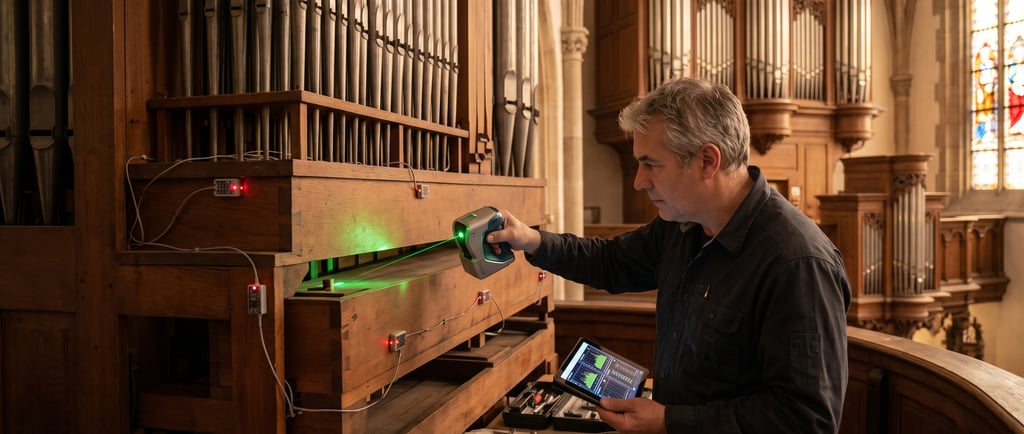
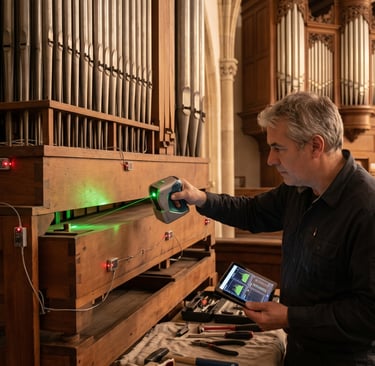
Preserving Heritage: Advanced Windchest Leak Detection and Hygrometric Monitoring in Historical Organs with GUBELOG-01
Historical pipe organs are marvels of mechanical engineering and acoustic artistry. However, preserving these centuries-old instruments presents a unique set of challenges. Composed primarily of organic materials like wood and leather, they are highly susceptible to their environment.
For organ builders, restorers, and conservators, two of the most insidious threats to an instrument's sound and structural integrity are windchest air leaks and the hygrometric delta.
At Gubellini Electronics, we recognize that safeguarding these acoustic masterpieces requires more than just traditional craftsmanship; it demands precise, non-invasive modern diagnostics. This article explores the complexities of historical organ conservation and how our proprietary GUBELOG-01 system is engineered to monitor and protect these irreplaceable instruments.
The Complexities of Organ Conservation
To understand the solution, we must first examine the two primary forces that degrade a historical organ over time:
1. Windchest Air Leaks (Perdite d'Aria dai Somieri)
The windchest is the mechanical heart of the organ. It acts as a pressurized reservoir, directing air to the specific pipes selected by the organist. Because historical windchests rely on complex networks of wooden channels, sliders, and leather valves (pallets), even microscopic imperfections can lead to air leaks.
These leaks result in "bleeding" or "ciphering" (pipes sounding when they shouldn't), pressure drops that cause the organ to sound out of tune, and a general loss of acoustic power. Finding these leaks in a massive, enclosed structure using traditional methods is notoriously difficult and time-consuming.
2. The Hygrometric Delta Threat
Why do windchests develop leaks in the first place? The primary culprit is the hygrometric delta—the rate and extent of fluctuations in ambient humidity.
Antique wood is exceptionally hygroscopic. When humidity rises, the wood swells; when it drops, the wood shrinks. A high hygrometric delta over a short period causes extreme mechanical stress. This continuous expansion and contraction warp the wooden components of the windchest, crack the historical glues, and dry out the leather seals. The result is structural damage and the inevitable onset of air leaks.
The GUBELOG-01 Solution: Non-Invasive Precision
To combat these historical preservation challenges, Gubellini Electronics developed the GUBELOG-01. This advanced data acquisition and diagnostic system is designed to provide conservators with deep, real-time insights into the health of an organ without requiring invasive physical dismantling.
Modular Monitoring with CAN-Click Sensors
The physical data gathering of the GUBELOG-01 relies on our exclusive CAN-Click sensors. These miniaturized, highly adaptable sensor modules represent a leap forward in non-invasive diagnostic technology.
Discreet Placement: The incredibly compact nature of the CAN-Click sensors allows them to be placed strategically throughout the organ's casework, and even inside the windchests themselves, without interfering with the mechanical action or altering the acoustic properties of the instrument.
Unified Environmental and Pressure Tracking: By deploying a network of these sensors, conservators can simultaneously track the internal wind pressure of the chest and the micro-climate (temperature and humidity) immediately surrounding it.
Robust Communication Architecture: The CAN-Click sensors communicate with the main GUBELOG-01 unit via a highly resilient, noise-immune industrial network. This ensures that data collected from the deepest, most inaccessible parts of the organ is transmitted back with absolute synchronization and zero data loss, immune to the electromagnetic interference sometimes found in historic buildings and churches.
Intelligent Diagnostics via the Mathematical Engine
Raw data is only useful if it can be interpreted. The true diagnostic power of the GUBELOG-01 lies in its integrated mathematical engine, which processes the sensor data to provide actionable intelligence.
Hygrometric Delta Profiling: The system does not merely record humidity; the mathematical engine actively calculates the rate of change (the delta). By processing custom formulas, the system can alert conservators if the environmental shift exceeds the safe tolerance levels of the specific antique wood, allowing for intervention before physical warping occurs.
Micro-Leak Identification: During diagnostic testing, the mathematical engine analyzes the pressure decay curves from the windchest. By evaluating the relationship between internal volume, pressure drop over time, and ambient temperature, the system can mathematically identify the signature of micro-leaks long before they become audible to the human ear.
A Proactive Approach to Restoration
The preservation of historical organs can no longer rely solely on reactive repairs. Waiting for a windchest to fail or a pipe to cipher often means irreversible damage has already occurred.
The GUBELOG-01, powered by the exclusive CAN-Click sensor network and our advanced mathematical engine, abstracts the complexity of environmental and pressure diagnostics. It provides organ builders and conservators with a clear, precise, and continuous understanding of the instrument's condition.
By utilizing Gubellini Electronics' dedicated technology, the heritage sector can shift from reactive repairs to proactive conservation—ensuring that the voice of history remains intact for generations to come.
Contact
PHONE
info@gubellinielectronics.com
+39 3479200208
© 2025. All rights reserved.
GUBELLINI s.a.s. di Diego Gubellini & C.
Via Euridia Bergianti 10B 40059 Medicina BO Italy
VAT: IT03466001207

+39 3801978288
POLICY
APPLICATIONS
Refund policy
Terms and conditions
COMPANY