
Innovation in Industrial Drying Monitoring
Balance Point Management and Gradient Dynamics Using the GUBELOG-01 System
4/12/20269 min read
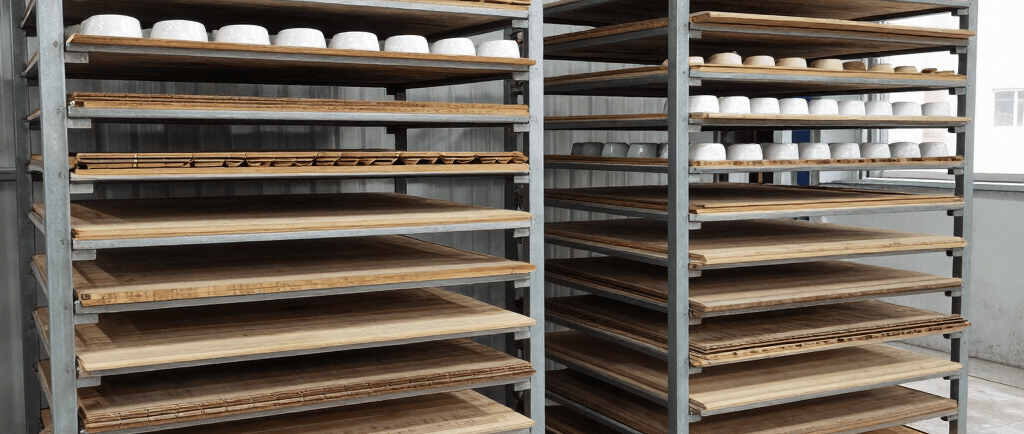
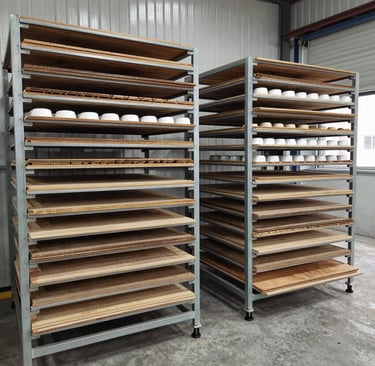
Innovation in Industrial Drying Monitoring: Balance Point Management and Gradient Dynamics Using the GUBELOG-01 System
The industrial drying of wood and ceramics is a fundamental pillar of global manufacturing chains, a process where material physics, thermodynamics, and control engineering converge in a challenge of pinpoint precision. It's not simply a matter of removing water from a solid, but of guiding a structural transformation that determines the aesthetic quality, mechanical strength, and longevity of the finished product. Historically, this sector has relied on the empirical experience of specialized operators, but the advent of Industry 4.0 and the need to drastically reduce energy costs—which can account for up to 30% of total production costs—are calling for a paradigm shift toward advanced digital monitoring. In this scenario, Gubellini electronics positions itself as a technology partner of excellence with the GUBELOG-01 datalogging system , an integrated architecture that transforms raw data into operational intelligence.
The Critical Role of Drying in the Wood and Ceramic Industries
Drying is a paradoxical phase: it is essential for the stability of the material, but it is also the moment when the risk of waste generation is greatest. For wood, water is a vital component that must be reduced to prevent fungal attacks and permanent deformations; for ceramics, the water in the mixture is what gives it plasticity, but removing it before firing is a very delicate step that can compromise the structural integrity of the piece.
The Hygroscopic Complexity of Wood
Wood is an anisotropic and hygroscopic material par excellence. Its cellular structure is designed to transport liquids, and this biological memory persists even after felling. Moisture content ( MC ) is not uniformly distributed, and its variation does not follow a linear logic. A fundamental concept is the Fiber Saturation Point (FSP), typically between 25% and 30%. Above this threshold, water is present in the cell lumens ("free water"); removing it requires thermal energy but does not cause significant dimensional changes. The real danger begins when the humidity drops below the FSP: water begins to leave the cell walls ("bound water"), triggering the material's shrinkage. If this process is not monitored with the precision guaranteed by the GUBELOG-01, internal stresses arise, leading to surface cracks, cell collapse, or permanent curvature.
The Shrinkage and Tensioning Phases of Ceramics
In ceramics, drying follows a different but equally complex process. Fresh clay contains a large amount of molding water, which separates the solid particles. During the first stage of drying, evaporation occurs at a constant rate from the wet surface. As the water evaporates, the clay particles move closer together, causing volumetric shrinkage that can reach 12%. When the particles come into contact, macroscopic shrinkage ceases, but residual moisture must still migrate from the internal pores to the surface. If the drying environment is not perfectly calibrated, the surface dries too quickly compared to the internal core, creating a destructive humidity gradient that cracks the piece or generates latent stresses that will then explode during firing.
Historical Issues and Challenges of the Professional Market
The wood and ceramic industries face unprecedented economic and technical challenges. In 2024, the ceramic machinery sector saw a 24% decline in production, forcing manufacturers to seek every possible operational efficiencies to protect margins.
The Humidity Gradient: The Invisible Enemy
The moisture gradient is the difference in water content between the "core" of the material and its surface. In an ideal drying process, surface evaporation should be perfectly synchronized with the rate of water diffusion from the inside to the outside. If evaporation is too rapid, "case hardening " occurs: the outer skin becomes rigid and impermeable, trapping moisture inside. This creates an imbalance of stresses: tensile on the outside and compressive on the inside. Without a datalogging system capable of simultaneously monitoring different levels of depth in the material, as the GUBELOG-01 does with its high-resolution inputs, the operator has no way of noticing the problem until it is too late.
The Hygroscopic Equilibrium Point (EMC) and Post-Process Stability
A common misconception is that drying is complete when the material reaches a certain average moisture content. However, true stability is dictated by the Hygroscopic Equilibrium Point (HEC). HEC is the moisture content that wood or ceramic tends to reach as a function of the temperature and relative humidity of the ambient air. If a piece of wooden furniture is dried to 12% but is installed in an office with an HEC of 8%, it will continue to lose moisture over time, causing shrinkage and cracking at the joints. The GUBELOG-01 solves this problem by calculating the drying chamber's target HEC in real time using its mathematical engine, allowing the cycle to be completed precisely when the material is in equilibrium with its future intended use.
Physical Parameter
Impact on Wood
Impact on Ceramics
Industrial Risk
Relative Humidity (RH)
Determine the final EMC
Adjust the evaporation rate
Post-sale deformations
Temperature (T)
Accelerate internal diffusion
Reduces the viscosity of water
Cellular damage / Breakages
Humidity Gradient
Transverse mechanical stresses
Radial shrinkage differential
High production waste
Dew point
Risk of condensation and stains
Evaporation inhibition
Energy inefficiency
electronics Solution : The GUBELOG-01 Ecosystem
The GUBELOG-01 data logger is not just a simple measuring instrument, but a distributed analysis station designed to operate in the harsh environments of industrial furnaces. With up to 38 simultaneous channels of acquisition and IPX7 insulation, the device can be installed near load points, reducing the length of noise-sensitive analog wiring.
Distributed Architecture and CAN-Click Sensor
The heart of the Gubellini system's flexibility lies in the integration of CAN-Click sensors . These intelligent sensors allow measurement points to be distributed throughout large drying chambers, connecting to the GUBELOG-01 central unit via a robust, shielded communication bus. This topology eliminates the signal losses typical of older analog systems and allows for unprecedented scalability.
CAN-Click Sensor for RTD (PT100)
Temperature measurement is the primary variable for controlling the energy supplied to the process. Gubellini electronics has developed an exclusive process for interfacing PT100 probes via dedicated CAN-Click sensors . Unlike thermocouples, which can suffer from thermal drift and require expensive compensation cables, platinum resistance thermometers guarantee millesimal precision and multi-year stability. The GUBELOG-01 uses this data to map the thermal gradient inside the oven, ensuring there are no "cold spots" where drying stagnates or "hot spots" that could damage the molecular structure of the materials.
CAN-Click Sensor for Moisture and Resistivity
To monitor the core of the material, Gubellini uses specific CAN-Click sensors for deep moisture detection. These modules measure the electrical resistivity of the wood or ceramic body using nail probes or contact capacitive sensors. Proprietary signal processing, managed by the sensor's microcontroller, filters out the electronic noise generated by the kiln's fan motors, returning a clean, analysis-ready moisture value to the data logger . By positioning sensors at different depths (e.g., superficial, median, and core), the GUBELOG-01 graphically displays the dynamic moisture gradient, allowing for active prevention of case hardening .
Integrated CAN-Click Environmental Sensors
Room management requires knowledge of air conditions. Gubellini electronics ' CAN-Click environmental sensors integrate air temperature, relative humidity, and barometric pressure measurements into a single digital node. This density of information is essential for calculating Vapor Pressure Deficit (VPD) and dew point, essential parameters for optimizing air flow and reducing cycle times.
The Powerful Math Processing Engine
The true strength of the GUBELOG-01 lies in its ability to process data "on the fly" using an internal mathematical engine . Instead of simply recording degrees Celsius or humidity percentage, the system performs complex physical calculations that describe the actual state of the process.
Moisture Content (EMC )
Using data from the CAN-Click environmental sensors , the mathematical engine applies advanced thermo-hygrometric equations, such as the Hailwood- Horrobin model , to determine the theoretical equilibrium humidity to which the material is tending. The implemented formula considers the variables $W, k, k_1, k_2$ as functions of the local temperature:
$$M_{ eq } = \frac{ 1800}{ W} \ left ( \frac{ kh }{1 - kh } + \frac{k_1kh + 2k_1k_2k^2h^2}{1 + k_1kh + k_1k_2k^2h^2} \ right )$$
Constant monitoring of the deviation between the actual moisture content of the material and the EMC allows the system to predict exactly when the drying cycle can be interrupted, ensuring energy savings that can exceed 12%.
Vapor Pressure Deficit (VPD) Analysis
To maximize mass transfer efficiency, the mathematical engine calculates the VPD, which is the true driving force behind evaporation. A VPD that is too low indicates that the air is nearly saturated and drying has stopped; a VPD that is too high signals excessive evaporation, which risks cracking the surface of the wood or ceramic. The GUBELOG-01 allows you to automate ventilation and misting systems based on the calculated VPD value:
$$VPD = 0.6108 \cdot \exp\left( \frac{17.27 \cdot T}{T + 237.3} \right) \cdot \left( 1 - \frac{H}{100} \right)$$
This proactive management, made possible only by the computing power of Gubellini electronics , transforms a passive oven into an intelligent adaptive system.
AI Analyst: The Intelligent Agent for Process Diagnosis
The introduction of the AI Analyst within the GUBELLINI DataStudio software represents a revolution in industrial monitoring. It's not just a simple alarm database, but a multi-agent system capable of "understanding" the production context.
Detection of Micro-cracks and Curve Anomalies
Ceramic drying is often threatened by imperceptible micro-structural failures during the process. The AI Analyst, loading the datasets recorded by GUBELOG-01, performs an automatic data audit to detect deviations from the ideal "drying signature." By analyzing the derivative of the water loss rate, the AI can identify the exact moment when the moisture content exceeded the material's plasticity threshold, alerting the operator that the batch may have hidden structural defects.
Predictive Maintenance of Engines and Heaters
Using the GUBELOG-01's integrated 6-axis IMU inertial platform, the AI Analyst can monitor the drying chamber's structural vibrations. Anomalies in the frequency spectrum (via FFT analysis performed by the mathematical engine) may indicate unbalanced fan blades or bearing wear due to high operating temperatures. This predictive maintenance approach prevents catastrophic downtime, particularly critical during drying cycles that cannot be interrupted without destroying the load.
Remote Monitoring and Global Control with GUBECloud
In a market where production is often distributed and logistics are international, remote data access is an invaluable competitive advantage. The GUBECloud service transforms the data logger into a network node accessible anywhere in Europe.
Custom Dashboards and Alarm Management
Through the cloud platform, quality managers can monitor oven status in real time on their smartphones or PCs. Dashboards can be configured to display critical indicators such as the current humidity level, target EMC, and estimated energy consumption. The system manages up to four independent hardware alarms that, in the event of an anomaly (such as a blocked burner or a sudden humidity spike), send instant push notifications and emails to operators.
Quality Certification and Historical Analysis
All collected data is securely stored on Gubellini electronics servers . This archive allows for automatic weekly or monthly reports to be generated that certify the correct drying cycle for each batch. For a manufacturer of fine wood or artistic ceramics, being able to provide customers with a graph demonstrating how the material has consistently remained within thermodynamic tolerance parameters is the ultimate tool for eliminating legal disputes and increasing the perceived value of the brand .
Application of GUBELOG-01 in Industrial Phases
electronics technologies brings tangible benefits throughout the product's lifecycle, from the conception phase to the final sale.
Plant Design and Planning
Oven and drying chamber manufacturers can use the GUBELOG-01 as a research and development tool. By mapping the chamber with dozens of CAN-Click sensors during prototype testing, they can visualize the actual fluid dynamics of heat and humidity, optimizing the positioning of air deflectors and reducing design inefficiencies. The ability to define "Auto-Start" conditions based on physical variables ensures that data is only recorded when the process is actually active, facilitating post-test analysis.
Production and Cycle Optimization
During large-scale production, the precision of the 12-bit ADCs and sampling rates of up to 200 Hz enable granular process control. The system can directly control external actuators (such as solenoid valves for misting or inverters for fans) via its programmable digital outputs, reacting instantly to changes detected by the mathematical engine. For example, if surface humidity drops too quickly compared to internal humidity, the GUBELOG-01 activates the nebulizers to "relax" the external fibers and allow diffusion to resume its natural course.
Sales and Customer Support
In the wood industry, selling finished products (furniture, parquet) requires ensuring the material doesn't move once installed. By using the GUBELOG-01 to monitor storage warehouses, the company can ensure the product remains aligned with the ideal EMC until shipping. Furthermore, the integrated GPS allows tracking environmental conditions during international container transport, verifying that temperature shocks or extreme humidity levels haven't compromised the quality of the cargo during transit.
Technical Specifications and Hardware Reliability
To operate successfully in heavy industry, ruggedness is not an option. The GUBELOG-01 is built with high-performance materials and automotive-grade connectivity.
Environmental Protection and Watertight Connectivity
The PA12 nylon casing and IPX7 rating ensure the data logger can withstand 100% humidity and chemical fumes found in drying chambers. The 26-pin JAE Electronics main connector uses silicone seals and snap-lock systems to prevent water and abrasive ceramic dust ingress, ensuring continuous data transmission even in the presence of extreme vibrations.
Data Management and Internal Memory
The datalogger saves data in RAW format on unformatted micro SD cards , ensuring data integrity even in the event of sudden power outages. Using the GUBELLINI DataStudio software , datasets can be downloaded at ultra-high speed via USB-C or extracted directly from the card for in-depth historical analysis. Supported memory of up to 128GB allows for continuous recording for months, ideal for the long natural seasoning cycles of hardwoods.
Hardware Feature
Electronics Specifications
Usefulness in Drying
Analog Inputs
8 channels (12-bit ADC)
Millesimal precision on gradients
CAN interface
Distributed architecture
Scalability on industrial ovens
Insulation
IPX7 / Nylon PA12
Resistance to steam and condensation
Integrated Sensors
6 -axis IMU + GPS
Engine vibration monitoring
Diet
7V - 24V DC
Compatibility with industrial panels
Conclusions: Towards Drying 4.0
The integration of the GUBELOG-01 system into the wood and ceramic drying processes represents not only a technical improvement, but a true economic transformation for the company. The ability to scientifically precisely manage the humidity gradient and the hygroscopic equilibrium point allows for lower energy costs, drastically reduced production waste, and the provision of certified quality end products.
Through the modularity of CAN-Click sensors , the analytical power of the mathematical engine , and the predictive intelligence of the AI Analyst , Gubellini electronics provides the tools to master the thermodynamics of materials. With the global monitoring offered by GUBECloud , quality control doesn't stop at the factory gates, but accompanies the product along the entire value chain, ensuring that every piece of wood and every ceramic slab reaches its maximum expression of stability and beauty. The era of intuition-based drying is over; with GUBELOG-01, the era of data certainty begins.
Contact
PHONE
info@gubellinielectronics.com
+39 3479200208
© 2025. All rights reserved.
GUBELLINI s.a.s. di Diego Gubellini & C.
Via Euridia Bergianti 10B 40059 Medicina BO Italy
VAT: IT03466001207

+39 3801978288
POLICY
APPLICATIONS
Refund policy
Terms and conditions
COMPANY