
Dynamic Analysis and ECU Calibration Validation on VAG Platforms: The Role of the Gubelog-03 Datalogger
Blog post description.
4/19/20267 min read
Introduction: The Limit of the Chassis Dyno and the Need for Dynamic Telemetry
In the modern car tuning landscape, particularly focusing on European electronic architectures like the Volkswagen-Audi Group's MQB platforms (EA888 Gen 3 and Gen 4, EA855 EVO engines), Engine Control Unit (ECU) calibration has reached an unprecedented level of complexity. Modern ECUs from Bosch (e.g., MED17, MG1) and Continental (Simos 18) operate on torque-based engine management models. In these systems, a single accelerator pedal request is translated into a torque setpoint, which the control unit attempts to achieve by manipulating boost pressure, ignition timing, variable valve timing (VVT), and fuel injection (both direct and indirect).
The historical limitation of automotive calibration is the exclusive reliance on the chassis dyno. Although the dyno is a fundamental tool for mapping under controlled conditions and quantifying power delta points, it fails to replicate three critical real-world road driving variables:
Dynamic Aerodynamic Load: Road load scales with the square of the speed. A fourth-gear dyno pull typically lasts 6 to 10 seconds. On the road, an equivalent acceleration or a highway pull exposes the engine to prolonged thermal load and aerodynamic resistance that the dyno's eddy current brake struggles to accurately simulate over long periods.
Cooling Efficiency (Ram Air Effect): Dyno fans cannot replicate the mass flow and dynamic pressure of the air passing through the intercooler and radiator at 200 km/h.
Thermal Adaptation of Sensors: Critical sensors like the TMAP (Temperature and Manifold Absolute Pressure) and thermocouples (EGT) are heavily influenced by engine bay heat soak—a phenomenon that manifests completely differently on the road compared to the dyno cell.
To bridge this gap, professional tuners and calibration engineers need to acquire real-time, ultra-high-frequency data directly from the moving vehicle. The use of standard OBD2 interfaces is limited by polling diagnostic protocols, which often do not exceed 10-20 Hz of total sampling rate—completely insufficient for analyzing transient phenomena like engine knock.
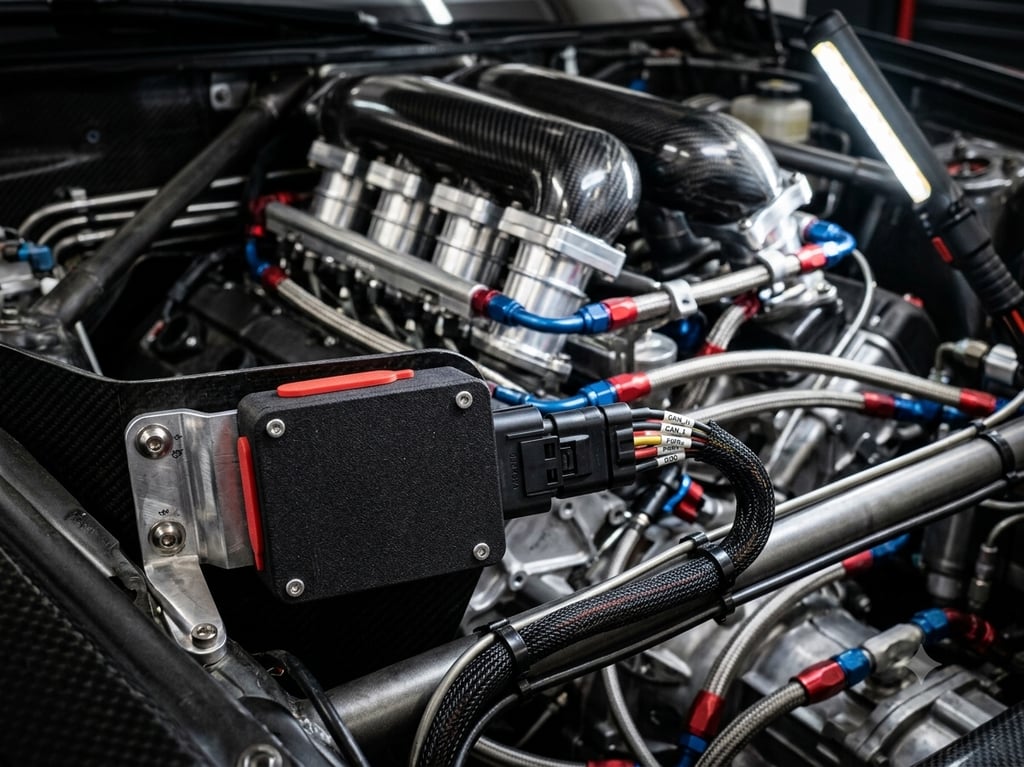
This is where the Gubelog-03 comes in: a datalogger designed for independent engineering firms requiring an elite tool capable of bypassing OBD2 limitations by interfacing directly with the vehicle's nervous system: the CAN bus.
1. Network Architecture and "Passive CAN Sniffing"
Modern vehicles use the CAN (Controller Area Network) protocol to allow dozens of control units (Engine, ABS/ESP, DSG Gearbox, etc.) to communicate. On the VW/Audi platform, the Powertrain CAN typically operates at 500 kbps.
The Gubelog-03 does not interrogate the ECU by requesting data (an active mode that saturates bandwidth and introduces latency); instead, it operates in Passive Sniffing mode. By connecting to the CAN-High and CAN-Low wires (often accessible from the gateway connectors under the dashboard or directly at the ECU wiring harness), the Gubelog-03 reads the entire raw data stream (in hexadecimal) that the control units naturally exchange.
1.1 CAN Frame Structure and Decoding
A standard CAN frame (11-bit identifier) transmits a payload of up to 8 Bytes. To transform these raw Bytes into understandable physical values, the free Gubelog-03 software uses .dbc configuration files (CAN Databases).
The general formula applied by the Gubelog-03 mathematical processor to convert the raw signal (RAW) into an engineering value is:
Physical_Value = (RAW × Scaling_Factor) + Offset
Practical Example on the MQB Platform (Simos 18): Suppose we want to read the throttle position. We intercept the CAN ID 0x280. We know that the data is contained in Byte 3. If Byte 3 returns the hexadecimal value 0x64 (which equals 100 in decimal), and the .dbc file defines a Scaling_Factor = 0.4 and an Offset = 0, the Gubelog-03 will record in real-time:
Throttle_Position = (100 × 0.4) + 0 = 40%
This passive listening architecture allows the Gubelog-03 to sample dozens of engine parameters simultaneously at frequencies exceeding 100 Hz per channel, capturing micro-variations that an OBD2 logger would miss entirely.
2. Critical Parameters and Thermodynamic Analysis with Gubelog-03
The power of an internal combustion engine is directly proportional to the air mass trapped in the cylinder and the efficiency with which it extracts energy from this air via combustion. The Gubelog-03 allows calibrators to monitor these parameters with surgical precision.
2.1 Boost Pressure and Intake Air Temperature
Increasing boost pressure via ECU remapping is the primary method for increasing power. However, compressing the air drastically raises its temperature.
According to the ideal gas law: P × V = m × R_specific × T
Where the air density (ρ) is: ρ = P / (R_specific × T)
An increase in pressure (P) increases density, but an increase in temperature (T) reduces it. If the turbocharger is pushed outside its maximum efficiency map (the so-called efficiency islands on the compressor map), the temperature increase negates the benefits of the pressure increase.
The Gubelog-03 allows simultaneous logging of:
Manifold Absolute Pressure (MAP)
Pressure Under Throttle (PUT)
Intake Air Temperature (IAT) pre- and post-intercooler.
The calibrator can create a math channel in the Gubelog-03 software to calculate the real efficiency of the intercooler (η_IC) using the equation:
η_IC = [(T_out_turbo - T_in_engine) / (T_out_turbo - T_ambient)] × 100
If the road logs show that during a prolonged pull, the IAT (T_in_engine) rises above 55°C and the intercooler efficiency drops below 60%, the tuner has irrefutable proof (to show the customer) that the vehicle needs a hardware upgrade before any further boost targets can be increased.
2.2 Knock Control (Knock Retard)
On high-performance engines, the ultimate limit for ignition timing (and thus thermodynamic efficiency) is engine knock, or detonation. Detonation is an uncontrolled auto-ignition of the air-fuel mixture (end-gas) at the edges of the combustion chamber, generating ultra-high-frequency pressure waves destructive to pistons and connecting rods.
Bosch and Continental ECUs use piezoelectric sensors to listen for these frequencies. When they detect the onset of knock, the ECU applies an instantaneous correction, reducing the ignition advance (Knock Retard).
Monitoring Knock Retard is perhaps the most vital application for the Gubelog-03 in the tuning sector. If data is recorded at a low frequency, the event could be missed completely. Thanks to high-speed acquisition via CAN, the logger records the degrees of timing retardation applied per individual cylinder.
An analysis graph in the Gubelog-03 software might show:
Cyl 1: 0.0°
Cyl 2: -0.8°
Cyl 3: -3.5°
Cyl 4: -0.5°
A constant retardation of -3.5° on cylinder 3, cross-referenced with high EGT temperatures, indicates a localized issue: it could be a slightly clogged injector (leaning out the mixture locally) or poor airflow distribution within the intake manifold. Without the data granularity provided by the Gubelog-03, the tuner could not identify this imbalance, risking engine failure over the long term.
2.3 Injection Analysis and Duty Cycle
On direct injection engines (FSI/TSI), the time window available to inject fuel is extremely limited because injection occurs during the compression stroke, working against rapidly rising cylinder pressures.
Injection time is measured in milliseconds (Injector Pulse Width, IPW). The fundamental parameter to analyze is the injector Duty Cycle—the percentage of time the injector remains open relative to the total time available for a full engine cycle (two crankshaft revolutions in a 4-stroke engine).
The free software included with the Gubelog-03 allows the creation of a dedicated math channel to calculate the instantaneous Duty Cycle (DC) as a percentage:
DC = ((IPW × RPM) / 120000) × 100
(Note: The constant 120000 comes from converting milliseconds, minutes, and the two engine revolutions per cycle).
If the Gubelog-03 logs reveal a Duty Cycle exceeding 90-95% at 6800 RPM, it means the injector is open almost constantly, losing its ability to properly atomize fuel (static injector). This is a critical warning sign: the engine requires upgraded high-pressure fuel pumps (HPFP) or higher-flow injectors.
3. Interconnected Vehicle Dynamics
A massive advantage offered by the Gubelog-03 over engine-only loggers is its versatility. Being connected to the global CAN bus, it listens not only to the ECU but also to the ABS/ESP, the transmission control unit (TCU for DSG/S-Tronic), and the Haldex (all-wheel-drive system).
3.1 Clutch Slip and Torque Management in the DSG Gearbox
In highly tuned vehicles (Stage 2 or Stage 3), the torque delivered by the engine often far exceeds the factory specifications of the dual-clutch transmission clutch packs. Modern TCUs (such as the DQ250 or DQ381) constantly measure clutch slip and communicate with the engine ECU to request a "Torque Reduction" if the slip exceeds safety thresholds.
The Gubelog-03 allows the calibrator to overlay graphs of:
Requested Torque (Pedal)
Estimated Delivered Torque (Engine)
Clutch Hydraulic Line Pressure (TCU)
Clutch Slip (RPM difference between the primary and secondary shafts)
If the log highlights a slip spike of 200 RPM at the peak of boost, followed by an abrupt timing cut by the ECU, the calibrator knows exactly that the issue does not stem from a knock or overboost cut, but from the mechanical inability of the transmission to hold the torque. The data-driven solution will consist of increasing the clutch disc clamping pressures via TCU remapping, or "smoothing" the torque delivery at mid-range RPM via the ECU, validating the changes during the next road test with the logger.
4. Elite Hardware and the "Zero-License" Software Ecosystem
For an independent engineering firm, the Gubelog-03 represents an investment with an extremely fast ROI (Return on Investment).
Mainstream brands in the industry often force the purchase of expensive hardware combined with annual software licenses to unlock advanced math functions, high-resolution exporting, or multi-window analysis. The Gubelog-03 is born from the opposite philosophy: robust, versatile hardware accompanied by free software that is fully unlocked in every feature.
Flexible Inputs: In addition to CAN bus sniffing, the logger features analog inputs (to integrate aftermarket sensors not present on the factory network, such as additional wideband Lambda probes or low-pressure fuel circuit sensors) and digital inputs.
Integrated GPS Module: Allows correlating engine parameter trends (e.g., oil cooling) with longitudinal/lateral G-forces and track position, essential if the vehicle is being tested on a circuit (Track Day).
Optimized File Management: Data is saved in formats that can be handled without latency. Exporting to CSV allows advanced engineers to automate file importing into Python or MATLAB to apply statistical filters or train neural networks on engine wear.
4.1 The Power of Autonomy for Small Engineering Firms
Considering that small and medium-sized family-run businesses cannot afford dedicated IT departments or staff exclusively focused on data analysis, the Gubelog-03 software is designed with a focused, logical interface. Creating a custom math channel or a layout template (Workspace) that instantly displays all 4 cylinders, Lambda, and target vs. actual AFR (Air Fuel Ratio) takes just a few clicks.
This drastically reduces downtime between calibration runs, ensuring high hourly profitability for the tuner. Furthermore, by providing such clear and mathematically irrefutable data, it helps educate clients, filtering out post-sale misunderstandings and minimizing the need for technical support: the log speaks for itself.
Conclusion
Calibration of modern automotive platforms is an exact science that leaves no room for guesswork. Relying exclusively on a chassis dyno means giving up on understanding the real dynamics of the vehicle. The Gubelog-03 serves as the central hub of intelligence between the calibrator and the machine, transforming invisible streams of hexadecimal data into temperature curves, efficiency maps, and knock histograms. It is the ultimate tool for those seeking maximum performance encapsulated in rock-solid reliability, supported by a software ecosystem that respects the needs and budgets of powertrain engineering professionals.
#CarTuning #ECUremap #CANbus #Datalogging #Gubelog03 #VAGtuning #MQBplatform #EngineCalibration #MotorsportEngineering #Telemetry #ChassisDyno #EA888 #TrackDayPrep #RaceCarEngineering #DataDrivenPerformance
Keywords
Professional automotive datalogger
Vehicle CAN bus analysis
VAG ECU calibration
MQB CAN data sniffing
Knock retard monitoring
IAT and boost pressure sensors
Injector duty cycle analysis
EA888 engine tuning
License-free datalogger
Motorsport data acquisition
Intake manifold absolute pressure
Tuning diagnostic tool
Intercooler efficiency calculation
Free telemetry software
MED17 control unit parameter reading
Dynamic on-road logging
Data acquisition hardware
Car performance technical analysis
Engine map optimization
Independent motorsport engineering
Contact
PHONE
info@gubellinielectronics.com
+39 3479200208
© 2025. All rights reserved.
GUBELLINI s.a.s. di Diego Gubellini & C.
Via Euridia Bergianti 10B 40059 Medicina BO Italy
VAT: IT03466001207

+39 3801978288
POLICY
APPLICATIONS
Refund policy
Terms and conditions
COMPANY